


Nature is not external to the economy
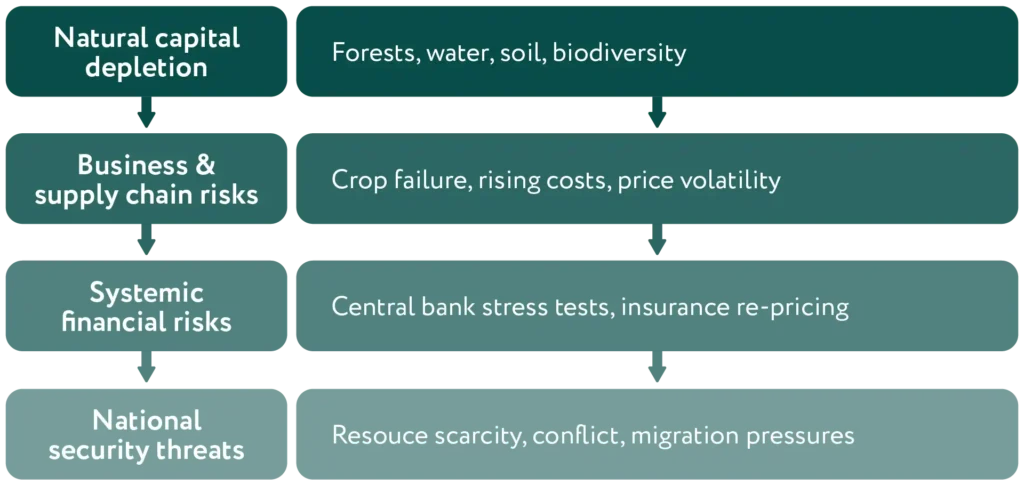
More than half of global GDP is moderately or highly dependent on nature and the services it provides, from pollination and water filtration to climate regulation and soil fertility. Agriculture, construction, food and beverage production, and pharmaceuticals all rely directly on functioning ecosystems. When those systems degrade, the economic consequences are not abstract: crop yields fall, input costs rise, insurance markets reprice risk, and entire business models lose their foundation.
This is why central banks, financial regulators, and institutional investors have started treating nature loss the way they treat climate change — as a systemic financial risk. Just as climate-related stress tests now examine exposure to carbon-intensive assets, “nature-related financial risk” frameworks are emerging to assess exposure to water scarcity, soil degradation, and ecosystem collapse. A bank with heavy exposure to agriculture in a water-stressed region, or a company dependent on a single, fragile supply chain for raw materials, is carrying risk that traditional financial models have largely ignored.
The supply chain vulnerability nobody priced in
Natural capital loss compounds existing supply chain fragility. Deforestation undermines the rainfall patterns that sustain agriculture thousands of kilometers away. Declining pollinator populations threaten crops worth hundreds of billions of dollars annually. Soil degradation reduces the productive capacity of farmland precisely as global food demand rises. These are not isolated environmental events — they are inputs into production systems that companies and countries depend on, often without redundancy or substitutes.
For businesses, this translates into real operational risk: price volatility, sourcing disruption, and reputational exposure as transparency requirements (such as the EU’s deforestation regulation or emerging nature-disclosure frameworks like TNFD) make supply chain dependencies visible to regulators, investors, and customers alike.
Why this becomes a security issue
The link between nature loss and national security is less obvious but no less real, and it tends to operate through three channels.
Resource scarcity drives instability. Water stress, depleted fisheries, and degraded farmland have historically been contributing factors in regional conflict and mass displacement. As ecosystems degrade further, competition over remaining productive land and water resources is likely to intensify, particularly in regions already under geopolitical stress.
Strategic dependencies become leverage points. Countries reliant on imported food, timber, or critical raw materials sourced from ecologically fragile regions face exposure not just to environmental shocks, but to the geopolitical actors who control access to those resources. This mirrors — and increasingly overlaps with — concerns about critical mineral dependencies.
Climate and biodiversity loss are mutually reinforcing. Ecosystem degradation accelerates climate instability, and climate instability accelerates ecosystem degradation. Defense and intelligence communities in multiple countries have already begun classifying this feedback loop as a “threat multiplier,” capable of intensifying existing security challenges from migration pressure to resource conflict, rather than introducing an entirely new category of risk.
From externality to strategic priority
The practical implication is that nature loss can no longer be treated solely as a corporate sustainability metric or a diplomatic talking point. It belongs in the same risk category as energy security, critical infrastructure resilience, and supply chain diversification — issues that finance ministries, defense planners, and corporate risk committees are paid to take seriously.
This shift is already visible in how some institutions operate. Investors are integrating nature-related risk into due diligence. Some governments are beginning to treat ecosystem resilience as part of broader resilience and security planning, alongside energy and cyber infrastructure. Companies with material dependencies on ecosystem services are starting to map and disclose those dependencies, not out of altruism, but because the alternative is being caught flat-footed by a risk they failed to price.
The organizations and governments that treat natural capital as a strategic asset — one to be measured, protected, and diversified against — will be better positioned than those that continue to treat it as a free, infinite input. Nature loss is no longer just an environmental story. It is an economic and security story, and the institutions that recognize this early will have a material advantage over those that don’t.