


For the past decade, corporate sustainability has been dominated by one objective: net zero. While reducing emissions is essential, it is becoming increasingly clear that without healthy ecosystems, achieving net zero becomes nearly impossible. Climate change and biodiversity loss are not separate challenges. They are deeply interconnected symptoms of the same systemic problem.
This is why the conversation is shifting from “doing less harm” to becoming nature positive: following the objectives of the Kunming-Montreal Global Biodiversity Framework to halt and reverse nature loss while restoring the ecosystems that underpin economic activity, climate stability, and human wellbeing. The question is no longer whether businesses should engage with nature restoration, but how quickly they can do so.
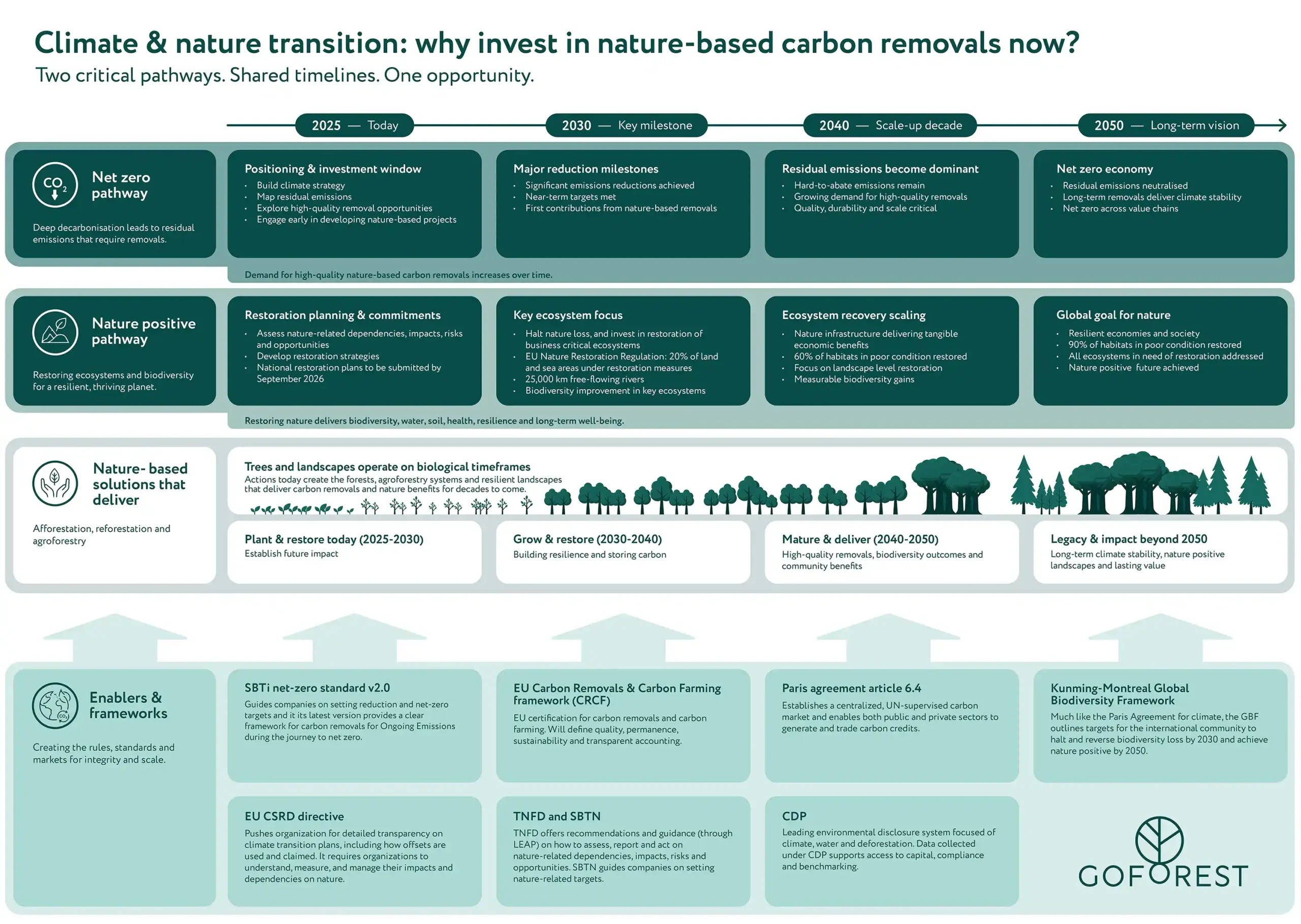
Net zero and nature positive pathways share timelines, with 2050 as a key horizon. And in fact, nature-based carbon removals offer an opportunity for both pathways to reinforce each other. Meanwhile, market initiatives and regulatory frameworks are moving to support scaling up action. 2050 seems like a long way ahead. So why invest in nature-based carbon removals now?
- Click to expand
Nature action moved from morality to materiality
Nature is declining at an unprecedented rate. Forests, wetlands, soils, and biodiversity are being degraded faster than they can recover. At the same time, companies are facing growing exposure to nature-related risks through disrupted supply chains, water scarcity, land degradation, and increasing regulatory scrutiny. More than half of global GDP is moderately or highly dependent on nature, making ecosystem degradation a material business risk rather than a purely environmental concern.
Waiting carries a cost. Ecosystem restoration takes time. A forest planted today will take years to mature. Wetlands require decades to fully recover.Companies that invest early can secure access to high-quality restoration opportunities, strengthen resilience in their value chains, and position themselves ahead of future market and regulatory developments.
Carbon markets 2.0
Indeed, carbon policies and the carbon market landscape is evolving quickly and timelines are converging. The SBTi Net-Zero Standard v2.0 is expected to increase demand for high-quality removal projects by formally recognizing the use of eligible carbon credits within net-zero strategies. In Europe, the EU Carbon Removals and Carbon Farming Certification Framework (CRCF) will define quality thresholds, though it remains unclear which standards will be recognized. In parallel, Article 6.4 of the Paris Agreement will influence how removal projects participate in compliance and voluntary markets.
Climate action is entering a new phase. Emission reductions remain essential, but nature-based carbon removals are gaining prominence as a way to address residual and ongoing emissions through restoration of ecosystems and the development of resilient landscapes. With operational phases between 2024 and 2028, companies face a strategic question: which nature-based removals to invest in, and when.
The emergence of nature and biodiversity markets
Alongside this shift, biodiversity and nature credits are beginning to attract significant attention from businesses, investors, and policymakers. Although methodologies and standards are still evolving, the direction of travel is clear: companies will increasingly be expected to understand, measure, and manage their impacts and dependencies on nature and address associate risks and opportunities. In fact, disclosure and target-setting frameworks such as TNFD and SBTN, or regulatory requirements under CSRD can support this movement and can inform invesment in nature restoration.
However, a well-designed restoration project can simultaneously generate carbon sequestration, biodiversity enhancement, water regulation, soil improvement, and community benefits. So rather than valuing only one outcome, stacking recognizes and rewards multiple ecosystem services generated by the same project. This creates a stronger business case for restoration by unlocking multiple value streams while reflecting the true value that healthy ecosystems provide.
Valorization of investment in nature-based carbon removals
Indeed, the new SBTi Net-Zero Standard formally recognizes the need for immediate climate AND nature action, by providing a framework to integrate and valorize carbon removal projects in the near-term. Importantly, carbon removals and credits are not a substitute for emissions reductions. However, under the OER program (Ongoing Emissions Responsibility) companies are stimulated to complement reduction efforts by recognizing carbon removal projects that remove carbon and provide value for nature restoration and local communities.
Also investors increasingly expect companies to demonstrate credible action beyond carbon or nature alone. And disclosure requirements and platforms facilitate this. For example, the EU’s CSRD[1] requires transparency on climate transition plans, including the use of carbon credits and removals under ESRS E1. Nature-based carbon removals may also contribute to ESRS E3 and E4 by supporting water infiltration, ecosystem restoration and biodiversity improvement, and delivering social benefits to be valorized under S2 and S3. Similarly, CDP reporting can benefit from investments in nature-based solutions through stronger climate, forest, and water disclosures. [1] Both EU CSRD as a mandatory framework and the voluntary VSME framework provide datapoints corporates as well as SMEs can meet.
What is you next step?
The companies that lead in the next decade will be those that recognize nature as a critical business asset. By investing in high-quality restoration projects today, organizations can reduce nature-related risks, strengthen supply chains, contribute to climate goals, and position themselves within the rapidly evolving markets for carbon, biodiversity, and ecosystem services.
At Go Forest, we support and co-develop afforestation, reforestation and agroforestry projects that contribute to climate goals, biodiversity objectives, and community development simultaneously. We help you valorize engagement with these forest projects through impact data delivery, alignment with nature and climate strategies, disclosure frameworks or regulation.
Do you want to understand how markets and regulations are moving, and how our projects can support you in your climate and nature journey?
Get in touch: https://calendly.com/wouter-goforest