
Companies are under increasing pressure to show that their sustainability strategies deliver measurable impact. One of the most strategic choices they face is how to approach ecosystem restoration. Should projects be linked to carbon credit certification or should they focus on non-certified initiatives? As the Corporate Sustainability Reporting Directive (CSRD) reshapes disclosure requirements across Europe, this decision has become a matter of credibility and compliance, with direct implications for long-term strategy. This article will help you understand when to choose certified versus non-certified projects, and how each option fits within the CSRD framework.
Understanding the landscape
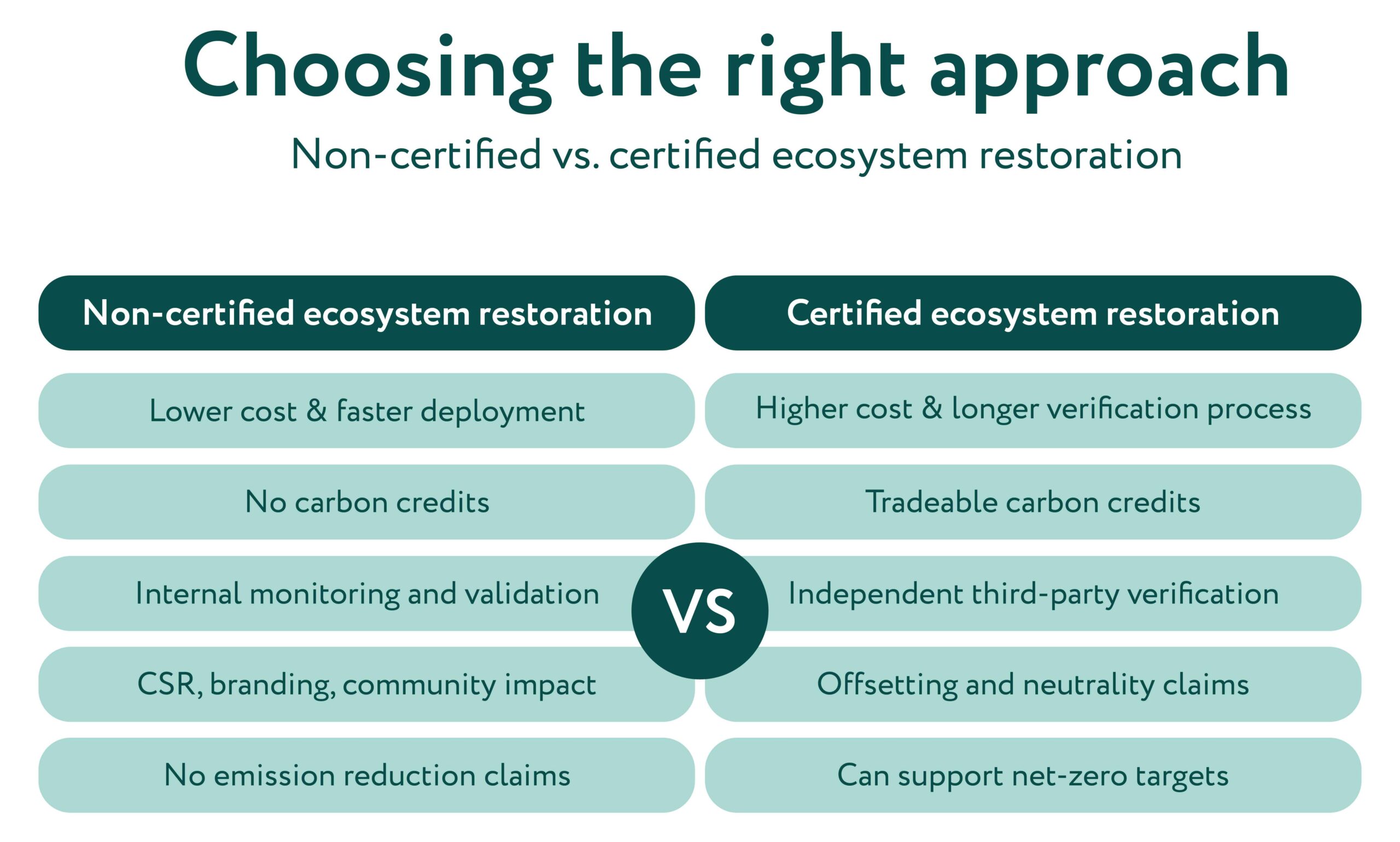
Ecosystem restoration initiatives can be approached in two ways, each with its own advantages and implications for companies.
Certified projects are developed under recognized third-party standards such as Gold Standard, Plan Vivo or Verra’s Verified Carbon Standard (VCS). They follow established methodologies, undergo independent validation and verification and generate carbon credits that can be traded or retired. These credits represent verified emission reductions or removals, which makes certified projects particularly valuable for companies that need recognized, reportable outcomes within compliance or voluntary carbon markets.

Non-certified projects are implemented without pursuing formal carbon credit certification. They may still include strong monitoring practices and deliver meaningful ecological and social benefits, but they do not follow the methodologies required for issuing carbon credits. While these projects cannot generate transferable credits, they can strengthen local impact, build stakeholder trust and demonstrate commitment to biodiversity and community engagement.
Non-certified ecosystem restoration projects
When to choose non-certified projects?
Non‑certified restoration projects are the right choice for companies that want to demonstrate environmental commitment without the overhead of formal carbon credit accounting. They are particularly effective for creating visible programs that engage employees and stakeholders, while also reinforcing the company’s reputation as responsible and forward‑looking. By avoiding the lengthy certification process, they allow companies to act quickly and control costs by sidestepping fees for validation, verification, registries and audits.
This approach is most suitable when the primary objective is marketing, CSR, employer branding, stakeholder relations, biodiversity restoration or community livelihoods rather than formal offsetting. It is also relevant when budgets are constrained, since certification can be prohibitively expensive for small to mid‑sized projects. Non‑certified projects provide speed and flexibility, enabling companies to deploy restoration rapidly or adaptively without being locked into rigid methodologies and multi‑year verification cycles.
The limitation is that non‑certified projects cannot generate third‑party verified carbon credits or support marketable net‑emissions offset claims. This means stakeholders may treat the results with more scepticism unless transparent monitoring, reporting and independent checks are provided. For companies that value agility, visibility and impact, however, non‑certified projects can be a powerful way to integrate restoration into broader sustainability strategies.
The Go Forest approach
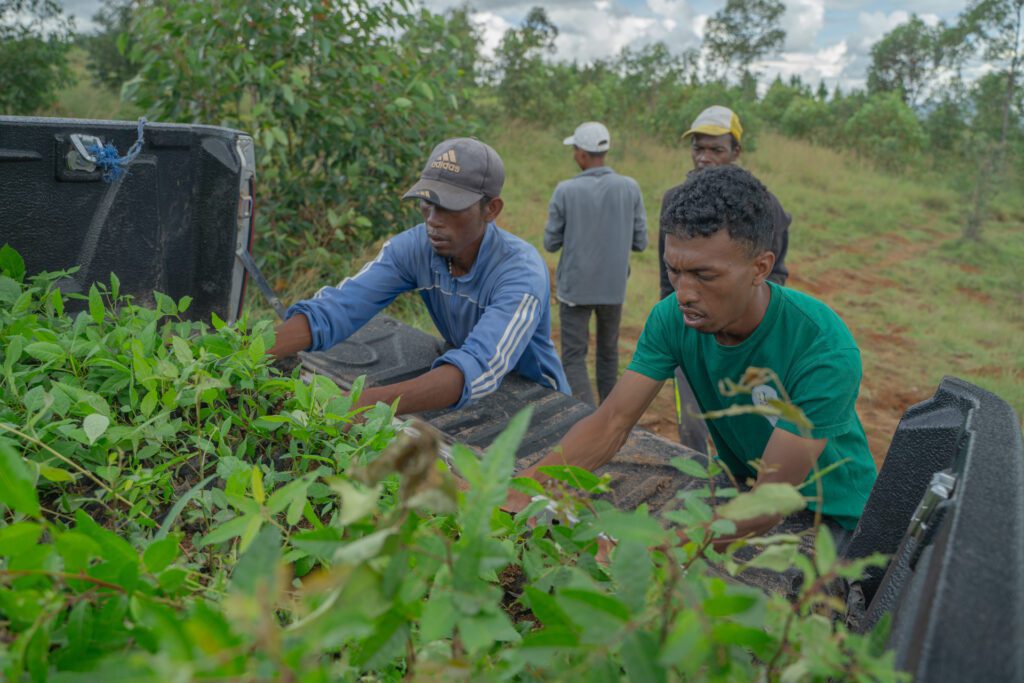
Even without formal certification, high‑quality non‑certified projects can deliver credibility when they are built on rigorous due diligence and transparent monitoring. At Go Forest, the due diligence covers ecological indicators, nursery practices, operation procedures, community benefits, land ownership, planting methods and internal structures. The projects are also visited on‑site to verify practices and ensure that restoration efforts are implemented as planned. This ensures that every project is evaluated for ecological outcomes, with a strong emphasis on the importance of local communities. These communities benefit directly through employment opportunities and improved living standards, creating long‑term social impact alongside ecological recovery.
Monitoring is guaranteed by our local partners, who oversee progress directly in the field. Starting in 2026, Go Forest will add an extra check with advanced remote sensing tools, providing clear evidence of restoration outcomes and giving stakeholders confidence in the results. By combining local expertise with technological verification, performance is tracked accurately and transparently.
To add an extra layer of assurance, Go Forest offers the Guarantree label, a trusted certification for companies investing in nature restoration. The label confirms that each contribution leads to measurable ecological restoration and long‑term environmental impact. Validation is carried out by Vinçotte, a leading inspection and certification body, which guarantees the highest levels of transparency and credibility.
By integrating rigorous due diligence, guaranteed monitoring, advanced remote sensing checks and the Guarantree label, Go Forest provides companies with confidence that their non‑certified projects meet high standards of quality and reliability. This approach ensures that restoration efforts are ecologically sound, supportive of local livelihoods and financially accessible.

CSRD reporting for non-certified projects
Non‑certified restoration projects can be reported under the CSRD, provided they are disclosed correctly and transparently. CSRD sets the legal obligation to report, while the European Sustainability Reporting Standards (ESRS) provide the framework for how that reporting must be done. For non‑certified projects, the most relevant standards are ESRS E4 on biodiversity and ecosystems, ESRS E1 on climate change, ESRS S3 on affected communities and ESRS 2 on general disclosures.
Under ESRS E1, non‑certified projects can be reported as financed climate‑mitigation actions, provided companies clearly explain the uncertainty and the absence of certification. They must not be presented as carbon offsets, deducted from Scope 1, 2 or 3 emissions or used to claim net‑zero status. Any estimated carbon impacts must be disclosed only as indicative, non‑verified values, with clear explanation of their limitations. Disclosures should describe the project’s aims, estimated sequestration potential, the monitoring approach, the contribution to transition plans or climate strategy and any intention to certify in the future.
Under ESRS E4, non‑certified projects are particularly relevant as they address ecosystem degradation, restore habitats, enhance biodiversity or contribute to conservation efforts. Companies should disclose where projects operate, the biodiversity objectives, stakeholder and community engagement, safeguards and measurable outcomes. This is often the strongest area for non‑certified restoration, because ESRS E4 emphasises positive ecosystem impact and social benefits rather than carbon credit issuance.
Under ESRS S3, non-certified restoration projects should be reported when they create positive impacts for affected communities. Even when projects occur outside your operational footprint, communities benefiting from ecosystem restoration become “affected communities” through contributions to their livelihoods and local environment. Companies must disclose how projects impact communities, including employment opportunities, engagement processes, access to resources and capacity building initiatives. If restoration projects represent meaningful investment and deliver substantial community benefits, they should be reported transparently under ESRS S3, demonstrating how environmental actions create positive social outcomes for the communities involved.
ESRS 2 provides the cross‑cutting framework for strategy, governance and due diligence. Non‑certified projects can be reported as part of a company’s business model and CSR strategy, as material impacts, risks and opportunities if nature loss or climate change are relevant, and within governance disclosures to show how decisions on financing nature are made. Go Forest’s due diligence, monitoring, community engagement and safeguards can be referenced here, legitimising the project within the company’s sustainability governance structure.
In practice, non‑certified projects can and should be disclosed under CSRD, but they must be framed as financed mitigation or biodiversity actions rather than as certified offsets, emission removals or carbon neutrality claims. Transparency is essential. Any estimated carbon impacts must be reported as indicative, non‑verified values, with clear disclosure of uncertainty ranges, monitoring limitations and the absence of third‑party certification. Companies should communicate openly about the nature and scale of activities, the monitoring and verification methods applied, the intended climate effects and the social benefits delivered to local communities. By doing so, they demonstrate accountability and ensure their reporting aligns with the ESRS framework.
Certified ecosystem restoration projects
When to choose certified projects?
Certified projects are essential when companies need to make carbon neutrality or net‑zero claims with credible backing. Certification is also indispensable for companies that trade or retire carbon credits in voluntary carbon markets or that want to demonstrate alignment with the highest international standards and regulatory frameworks. In these cases, high‑quality carbon credits are necessary to support voluntary carbon strategies and to provide clients or investors with verifiable reductions or removals.
Certification ensures third‑party assurance of key integrity criteria such as additionality, permanence, leakage accounting and robust baselines. It allows companies to make strong, defensible claims.
There are, however, costs and trade‑offs. Certification adds time and expense, and some standards have historically faced criticism over integrity issues. Due diligence and close attention to updated methodologies remain therefore crucial.
The Go Forest approach
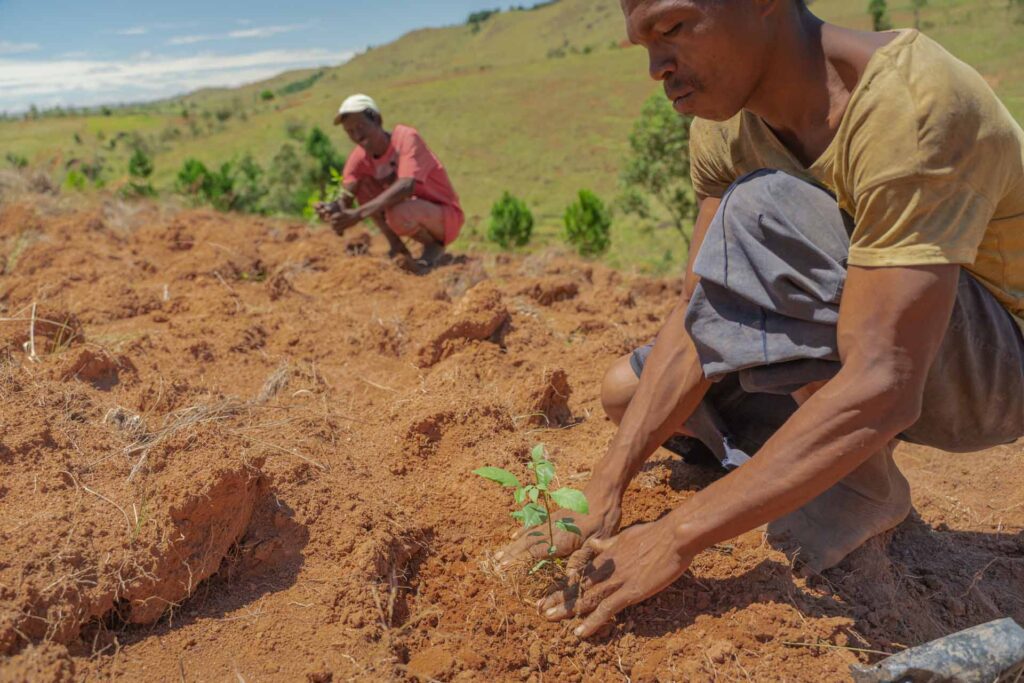
Go Forest applies the same philosophy to certified projects as to non‑certified ones: planting the right trees in the right locations, with a strong emphasis on local communities and long‑term ecosystem health. Projects are not just a transfer of funds. Partners can follow their impact through our digital platform, which provides transparent monitoring and regular updates on project progress.
For certified projects, we collaborate with three internationally recognized standards. Gold Standard emphasizes sustainable development goals and strong community co‑benefits. Plan Vivo specializes in community‑based forestry and benefit‑sharing with local smallholders. Verra’s Verified Carbon Standard (VCS) is the most widely used program globally, offering broad recognition in voluntary carbon markets.
By combining our community‑focused ecosystem restoration model with these trusted certification pathways, Go Forest enables companies to choose the level of assurance and impact that best matches their sustainability goals, while ensuring that every project remains transparent and accountable.
CSRD reporting for certified projects
Certified carbon credits receive more favorable treatment under CSRD, particularly within ESRS E1, but strict disclosure rules apply. Companies must disclose the total credits retired in the reporting year, broken down into reduction projects (such as avoided deforestation) and removal projects (such as reforestation). For removal projects, it is necessary to specify whether they are nature‑based, like forests and wetlands, or engineered, such as direct air capture. Companies must also name the certification standard. Another key distinction is whether projects fall within the company’s value chain or outside it. Credits linked to value chain activities can affect Scope 1‑3 inventories, while credits from external projects must be reported separately.

If a company makes net‑zero or carbon neutrality claims, additional disclosures are required. These include explaining how claims are accompanied by emission reduction targets, clarifying that credits complement rather than replace direct reductions and demonstrating the credibility of credits used, including permanence and additionality. ESRS E1 also requires that carbon credits cannot be included in gross emission reduction targets. For net‑zero targets, companies must explain how residual emissions (after achieving 90 to 95 percent reductions) will be neutralized and specify the role of credits in that process. Carbon credits do not reduce reported emissions. They must be reported separately and double counting is prohibited.
Certified projects also integrate with ESRS E4, which covers biodiversity and ecosystems. Carbon credit projects often deliver co‑benefits such as biodiversity enhancement, habitat restoration and conservation. Companies should disclose the project location and ecosystem type, biodiversity objectives, stakeholder and community engagement, safeguards and governance measures and outcomes.
Certified projects provide independent verification of social safeguards and community impacts, strengthening CSRD disclosure credibility. Standards like Gold Standard require free prior and informed consent, stakeholder consultation throughout the project lifecycle and grievance mechanisms for community concerns. Plan Vivo emphasizes community-led approaches with long-term benefit-sharing arrangements and participatory monitoring. This third-party validation demonstrates robust due diligence processes, which can be directly referenced in ESRS S3 reporting as evidence of responsible project implementation. Certification offers assurance that community safeguards have been independently assessed and monitored throughout the project, providing credible evidence of positive social outcomes alongside environmental benefits.
Finally, certified projects must be included under ESRS 2, which covers governance, strategy and due diligence. Companies should explain how projects align with their sustainability strategy and long‑term climate and biodiversity goals, disclose material risks such as non‑permanence or leakage and describe governance processes for selecting and financing projects. Due diligence procedures, including independent verification reports and monitoring, should also be reported.
Transparency is critical. Even for certified projects, companies must disclose verification and certification details, monitoring and reporting approaches, risks to permanence and any assumptions or limitations. This ensures stakeholders clearly understand the quality and credibility of carbon credits and the broader ecosystem benefits, while avoiding misrepresentation or over‑claiming.
Further information and support
For more information, you can visit our website or contact us directly at info@goforest.be. Go Forest offers both certified and non‑certified projects with transparent monitoring through our impact platform. We provide guidance on project selection and long‑term ecosystem restoration tailored to corporate sustainability goals, ensuring partners can clearly follow the ecological and social results of their contribution.